The project that turned me into a Claude Code believer
I feel great about the website I’m building — and terrible for professional website builders. PLUS: Who will stop Grok? And ChatGPT will see you now

This is a column about AI focused on Claude Code. My boyfriend works at Anthropic, which makes Claude. I decided to write this post after seeing a surge of enthusiasm for Claude on social media over the break and becoming curious about how it may have improved since I last tried it a year ago. See my full ethics disclosure here.
I.
The first time I built a website was in 1998. I had just arrived on campus as a freshman at Northwestern University, armed with a new personal computer I had built with a friend and a copy of Microsoft FrontPage. FrontPage was released 30 years ago as what was then called a WYSIWYG editor for websites. It let someone like me, who had not yet learned the rudiments of HTML, take a basic website template and put something of myself on the internet. My school offered basic web hosting to every student and faculty member; I used FrontPage to set up my home on the web.
Over the next half-decade, I built a handful more websites. I left FrontPage for a more powerful website builder called Dreamweaver, and used it to create a simple blog. After I graduated, I built a new blog on my own domain, powered by blogging software called Movable Type.
I loved having websites, but I never particularly enjoyed building them. I am not a technical person, and while basic HTML is quite approachable for beginners, I longed to create websites as personalized and customized as the greats. (Folks like Jason Kottke and John Gruber have been lifelong inspirations in this regard.) After lots of Googling and several rounds of trial and error, I could usually create something adequate to my purposes. But I don't know that I ever built something that I loved.
By 2007, when I next felt the urge to blog, I didn't even consider building a site of my own. A new "microblogging" service called Tumblr had just been created, and part of its promise was that it would take care of all the nettlesome hosting and design details for you. In 2020, when I launched Platformer, I chose Substack as my host for largely the same reasons I had chosen Tumblr a decade previously: web design, a discipline that once felt barely within my grasp, now felt totally out of reach.
I suspect it would have felt that way forever, had it not been for the advent of LLMs. Gradually and then suddenly, it became possible for a novice to create and publish a website. And the more that the tools improved, the more curious I got.
Last February, the AI researcher Andrej Karpathy coined the term "vibe coding" to describe the act of building software with LLMs, while barely paying attention to the underlying code. "It's not too bad for throwaway weekend projects, but still quite amusing," he wrote. "I'm building a project or webapp, but it's not really coding — I just see stuff, say stuff, run stuff, and copy paste stuff, and it mostly works."
To the surprise of most, vibe coding became a genuine phenomenon. It turned out that what was true for an experienced software veteran like Karpathy was true for amateurs as well. My nontechnical Hard Fork co-host Kevin Roose built a simple hot tub maintenance app for me a few weeks later; it felt more like a proof of concept for vibe-coding than a serious tool. (I abandoned it in frustration after a few days.)
Almost a year later, though, the leading large language models are much more powerful they were than when we ran our first vibe-coding experiments. In particular, the launch of Claude Opus 4.5 in November seemed to trigger a fresh wave of interest in the practice. When paired with Claude Code, an agentic command-line tool that lets you delegate tasks to Claude from your terminal, Opus 4.5 seemed to enable powerful new possibilities.
As Jaana Dogan, a principal engineer at rival Google, put it in a post with more than 8 million views: "We have been trying to build distributed agent orchestrators at Google since last year. There are various options, not everyone is aligned... I gave Claude Code a description of the problem, it generated what we built last year in an hour." (She had begun her post with: "I'm not joking and this isn't funny.")
Shakeel Hashim, founder of the AI safety-focused newsletter Transformer, captured the sentiment of many people I follow earlier this week with a post titled "Claude Code is about so much more than coding." He writes:
Claude Code has implications for everyone, not just the developers that have already been wowed by it. Claude Code doesn’t just generate code for engineers to review and deploy. It uses code to accomplish tasks. The “Code” in its name is misleading, and undersells the actual product: a general-purpose AI agent that can do almost anything on your computer.
I read Hashim's post and I wondered: could it build me a website?
II.
As it so happens, over the break my boyfriend had installed Claude Code on my computer. (Romantic.) One weekend, I came up with a (mediocre) idea for an app, and 30 minutes or so later, it was usable on my phone. The important thing about this exercise was that, thanks to the app-building exercise, most of the infrastructure I needed to use Claude Code effectively was now in place. I now had a GitHub account, and Claude had the permissions it needed to use my browser.
And so, a few days ago, I opened Claude Code in a terminal app called Ghostty (another suggestion from my boyfriend) and told it I wanted to build a website. For more than a decade, I had hosted a simple, business-card style website using Squarespace. I had never been particularly happy with the design, but had grown tired of wrestling with Squarespace's rigid templates. I was, for some reason, paying the company almost $200 a year for a static page that did nothing for me.
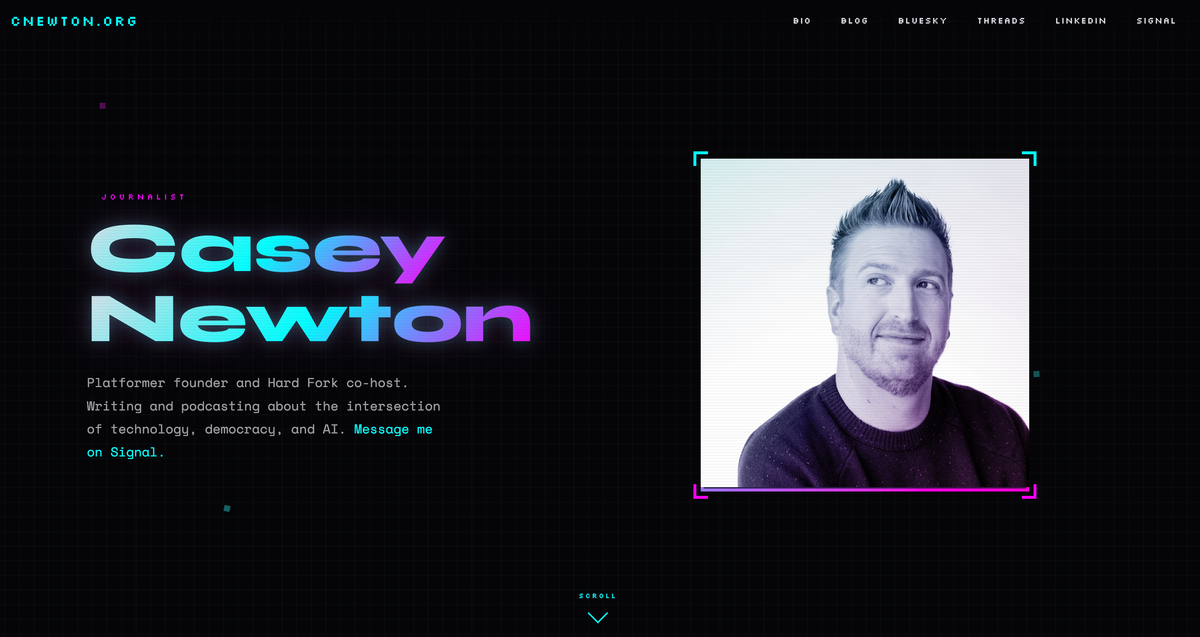
I told Claude I wanted to build something bold, and a little dramatic. I wanted hints of pixel art and other touches that would convey a sense of "tech." The page should have a short bio, and links to my projects. I set it to work.
Within a couple minutes, Claude had given me a working prototype. It rendered the website's name and an adjacent menu in pixelated font. At the top of the site, it left a space for a headshot. It took a first crack at writing a bio for me.
Over the next hour, I told Claude what I wanted to do in plain English. I added a menu of links to my profiles on Bluesky, Threads, and LinkedIn, as well as to my Signal. I added the headshot. I added an animated loading screen, and even more useless animation for anyone who accidentally clicks or taps on my face.
I added sections for Platformer and Hard Fork, and had Claude Code pull in recent stories and episodes, ensuring that the page always remains fresh. I added a box that lets you subscribe to Platformer if you haven't already. I added a feed of my most recent posts on Bluesky, and a Spotify playlist.
I posted my site, for free, to a service called Netlify. And I canceled my Squarespace account.