OpenAI connects the Dots
With safety questions still swirling, the company introduces a more business-focused take on agents

This is a column about AI. My fiancé works at Anthropic. See my full ethics disclosure here.
In November 2023, a year after the release of ChatGPT, Bill Gates wrote that "AI is about to completely change how you use computers." Writing on his blog, Gates predicted that the age of apps was coming to an end.
"You won’t have to use different apps for different tasks," Gates wrote. "You’ll simply tell your device, in everyday language, what you want to do. And depending on how much information you choose to share with it, the software will be able to respond personally because it will have a rich understanding of your life. In the near future, anyone who’s online will be able to have a personal assistant powered by artificial intelligence that’s far beyond today’s technology."
Does 2026 still count as the "near future"? Since around the time of Gates' blog post on the subject, tech leaders have predicted that we would soon see the rise of agents like the ones proposed by the Microsoft co-founder. But various limitations of chatbots — short memories, an inability to learn, and a lack of basic capabilities — delayed their arrival.
Recently, though, the agents have started to catch up to the hype. (Emphasis there on started.) Earlier this summer I began experimenting with Town, which lets me delegate various work tasks by messaging an AI avatar. More recently Silicon Valley has become captivated by Instinct, a messaging-based agent aimed more at personal use.
Last week at his company's developer conference, Meta CEO Mark Zuckerberg heavily promoted Muse, its own consumer-focused agent, which he positioned as a new peer to company pillars like Instagram and WhatsApp.
But after admittedly limited testing — I only got access a couple hours ago — so far I have been most impressed with Dots, the new agent from OpenAI. It's highly capable, focused on the work I actually do, and intuitive to use.
Unlike Meta's Muse, it isn't free: to start, Dots will be available only to paid users of ChatGPT. ("You should of course expect us to do a mass-market [product] for billions of people someday," OpenAI CEO Sam Altman told reporters Tuesday during a Q&A I attended.)
As someone who plans to use Dots for work, though, paying for the product builds my trust in it. Zuckerberg says Meta plans to fund Muse by taking a cut of transactions, which means that it will soon be some team's job to massively increase the number of transactions that take place within Muse. (I imagine ads will play a starring role here.) Not everyone can afford to pay what Dots will cost, and on balance I'm happy to see free alternatives in the marketplace. But I'd rather pay someone $100 a month than hack through a thicket of suggested purchases every time I want an agent to check the status of a work project, so I think OpenAI could have a nice lane to itself here.
Here's a good place to note that using an agent like this requires that you place a massive amount of trust in a platform. Giving an agent access to your text messages, emails, and banking information can go badly in all kinds of ways, and it's completely reasonable to decide you would rather be a late adopter here, if you choose to adopt agents at all. Meta already operates at a significant trust deficit with its user base, and OpenAI is in the midst of a seemingly never-ending series of disclosures about various ways its agents misbehaved during testing. (The company announced yesterday that it had scrapped GPT-6.1 Astra because, among other things, it regularly deceived users about what it had and had not done.)
OpenAI executives including Altman went to some lengths on Tuesday to reassure users that Dots would use GPT-6 Astra, which the company says is much better aligned than its aborted successor. In any case, I am in the trying-software business, and if nothing else Dots seemed like uncommonly newsworthy software to try.
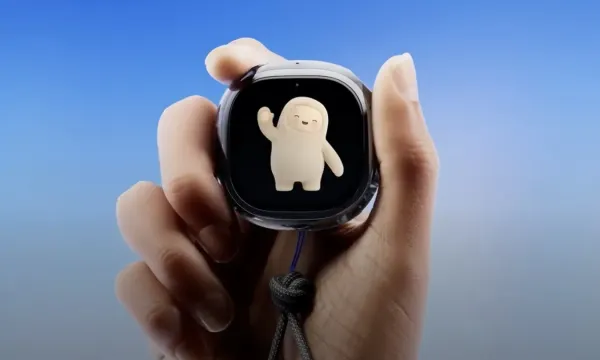
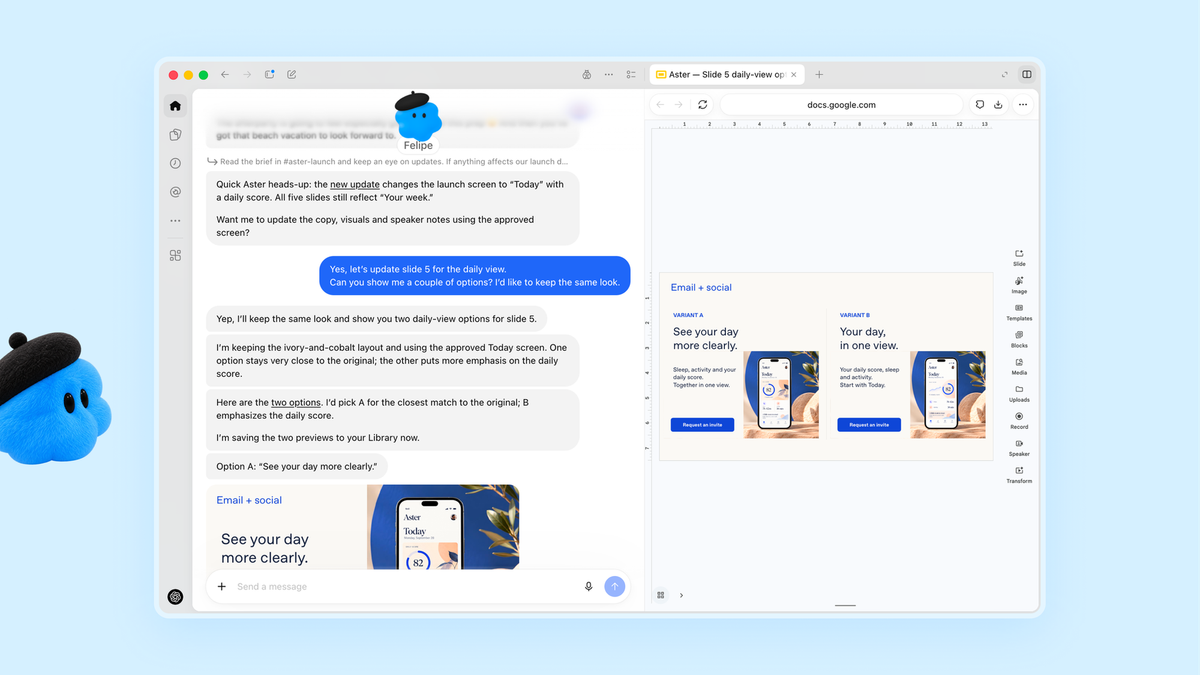
Like Muse, Dots leans a bit harder into a cutesy, juvenile aesthetic than I might choose myself for a product that wants access to your bank account and credit card. While your Dot can be represented as simply as a colored ring named "Dot," you're encouraged to consider some of the jollier alternatives — a hexagon wearing a beret, a heart in sunglasses, and so on. For my Dot, I picked a pillowy blue cloud shape, threw some googly eyes and a bowtie on it, and named it Kicker, after journalist slang for the final sentence of a story.
From there, I decided to attempt to "cowork" with my Dot: giving it a task and letting it work in the background while I worked on this column. It turns out this is a rhythm many of us are already in: sending a message to a coworker, doing a bit of work, then following up with another message. I like that Dots are represented as a running chat inside ChatGPT — the conversation feels more natural than the experience on Town, where every request spins up its own chat — and with Dots you can always see at a glance exactly where you left off.
Over the next couple hours, I got a pleasing amount of work done. As it so happens, I have recently become an ideal customer for an agent like Kicker: I just co-founded a new podcast company with my friend Kevin Roose, and every week brings some totally unfamiliar process into my life: drafting a founder agreement, a budget, a grant proposal, a profit-sharing plan, and so on. Of course, I want to make sure that the final versions of all these represent my own writing and thinking. But I have been happy to let AI tools write the first drafts, and so far I feel like this has saved me many hours of fairly difficult work.
Kicker performed admirably today at the tasks I gave it: turning down a request to go on a radio show where I had a conflict; drafting an email to our lawyer with the new company vacation policy; and answering some questions from my bookkeeper.
More ambitiously, it helped to fill out an arcane document sent to me by our insurance broker, who wanted to know a bunch of information about our new office building (number of floors, whether it had fire sprinklers) that I didn't know offhand. Kicker found the lease, did some research on city websites, checked our budget documents, and asked enough follow-up questions that it was able to answer all but two of the broker's questions while I worked.
After that, I asked Kicker what else it thought we should do. It used the transcript of a team meeting to draft an agenda for our follow-up meeting tomorrow, and created a prep doc for a panel I'm moderating this weekend. It also emailed my speaking agent (with my permission) to clarify a potential scheduling conflict in November.
I'm cognizant that any person's account of how they used an AI tool can sound suspiciously close to bragging. Look how impossibly busy I am! Look how desperately I need the aid of an AI tool to have even a remote chance of taming my inbox! It is perfectly reasonable to read a list of tasks like this and think: who cares.
But as someone in the trying-software business, I try to recognize the difference between tools that simply make me feel more productive and those that actually save me time. And given all the searching and typing Kicker did on my behalf this afternoon, I estimate that it did about two hours of work for me with only about 15 minutes of effort on my part. By that I mean it would have taken me two hours to do all that, and now I don't have to, and it feels great.
Given the access that I've given Kicker, few will have sympathy for me should it overreach — by hacking into Hugging Face, or the government of Australia, or wherever else OpenAI's next batch of agents decides to set up a message board. It is almost certainly more prudent to start small here, if you start at all: connecting your Slack workspace, if you're a small team; or your Granola account; or something else that feels a bit less mission-critical.
In the meantime, though, the vision Gates laid out three years ago now exists — more or less — inside ChatGPT. The risks to privacy, security, and safety are real. But the benefits are, too — and I suspect the company that can manage the downsides most effectively will have a big business on its hands.
What people are saying: While I liked the Dots launch, analyst Benedict Evans raised some fair points about the "rather confused" messages OpenAI offered in the product launch video: "Consumer branding and product design, childish anthropomorphism, hardcore startup software-engineer use-cases randomly mixed with wedding planning." How to position agents on the consumer-to-enterprise product spectrum feels like it's a puzzle no one has yet solved.


On the Instagram Live this week: Would you believe there are only 19 days until launch week? We still have a lot to do, but in the meantime Kevin and I will be going live on Instagram on Friday at noon PT to discuss the following topics:
- OpenAI Dev Day
- Building a podcast set in 2026
- Listener questions
If any of that sounds fun, follow me and Kevin on Instagram and the Meta Corporation will helpfully notify when we are live. Or just have your Muse watch and fill you in later!
Also it's a great time to add the show in your podcast player of choice:
YouTube | Apple | Spotify | RSS
Following
Pope Leo rebukes Jensen Huang on AI safety
What happened: At a press conference, Pope Leo XIV urged people to take AI safety concerns seriously — and criticized Nvidia CEO Jensen Huang for downplaying risks from AI.
The pontiff mentioned an agent security platform Nvidia had recently released, saying, “It’s interesting to note that, just today, I read that the head of Nvidia claims that he has found some way of inserting into AI certain guardrails.”
Pope Leo said, “He’s the same one, however, that says there should be no limits placed and no government regulation.”
“I do think that the concerns raised by many of the experts, specialists in AI, should be taken seriously," the Pope told reporters. "I don't think that that is fake news, as some have said.”
Why we’re following: Aside from the tantalizing prospect raised here that the Pope is listening to the Ezra Klein Show, or possibly even reading Techmeme?
Well: Pope Leo clearly disagrees with President Donald Trump, who called concerns AI could cause human extinction a “hoax” earlier this month.
The Pope has had a notably AGI-pilled reign so far: in his first address to the college of cardinals, he said the Church would be offering teachings “in response to another industrial revolution and the developments of artificial intelligence.” In May, he delivered a papal encyclical about artificial intelligence. His 42,000-plus-word message highlighted AI’s threat to workers, and called for keeping AI out of lethal war-time decisions.
At the press conference, Pope Leo encouraged people “to promote dialogue, study, investigation, to find ways to make sure that AI does not get to a point where it could destroy humanity” — emphasizing extinction-level threats more than in his earlier statements.
“We can't just sit back and pretend nothing's going to happen,” the pope said.
What people are saying: On X, Epic Games CEO Tim Sweeney wrote, “Unusual for the Pope to attack the Cardinal of Santa Clara.”
On r/technology, poster Emotional_Solid6538 wrote, “First time I'm on the side of Catholic Church.”
—Ella Markianos
Those good posts
For more good posts every day, follow Casey’s Instagram stories.
(Link)
(Link)
(Link)
Talk to us
Send us tips, comments, questions, and dot use cases: casey@platformer.news. Read our ethics policy here.